Is Luna Proxy Down? Verified 2026 Status After IPIDEA
Luna Proxy's domain no longer resolves after Google named it in the IPIDEA disruption. We separate confirmed facts from vendor claims and explain what buyers should do.
Updated July 12, 2026: In our checks, lunaproxy.com does not resolve in public DNS, and the service cannot be reached. Google named Luna Proxy as one of the brands controlled by the actors behind IPIDEA. The accurate summary is that Luna Proxy was materially disrupted and its original site is unavailable — not a separate, independent proof that every server and IP was permanently destroyed.
The honest answer separates three layers that people tend to blur together:
Website:lunaproxy.com returns no DNS answer in our tests, so the storefront, dashboard, sign-up and documentation cannot be loaded.
Retail service: account login, top-ups, endpoint generation, renewals and support cannot be verified through the original domain.
Backend network: Google seriously degraded the shared IPIDEA infrastructure, but later independent telemetry showed that parts of that pool survived, went dormant, or were rerouted through other channels.
For any real workload, treat Luna Proxy as unavailable and unsuitable for production. That is a stronger and more defensible statement than "the company was permanently liquidated," which the public evidence does not establish.
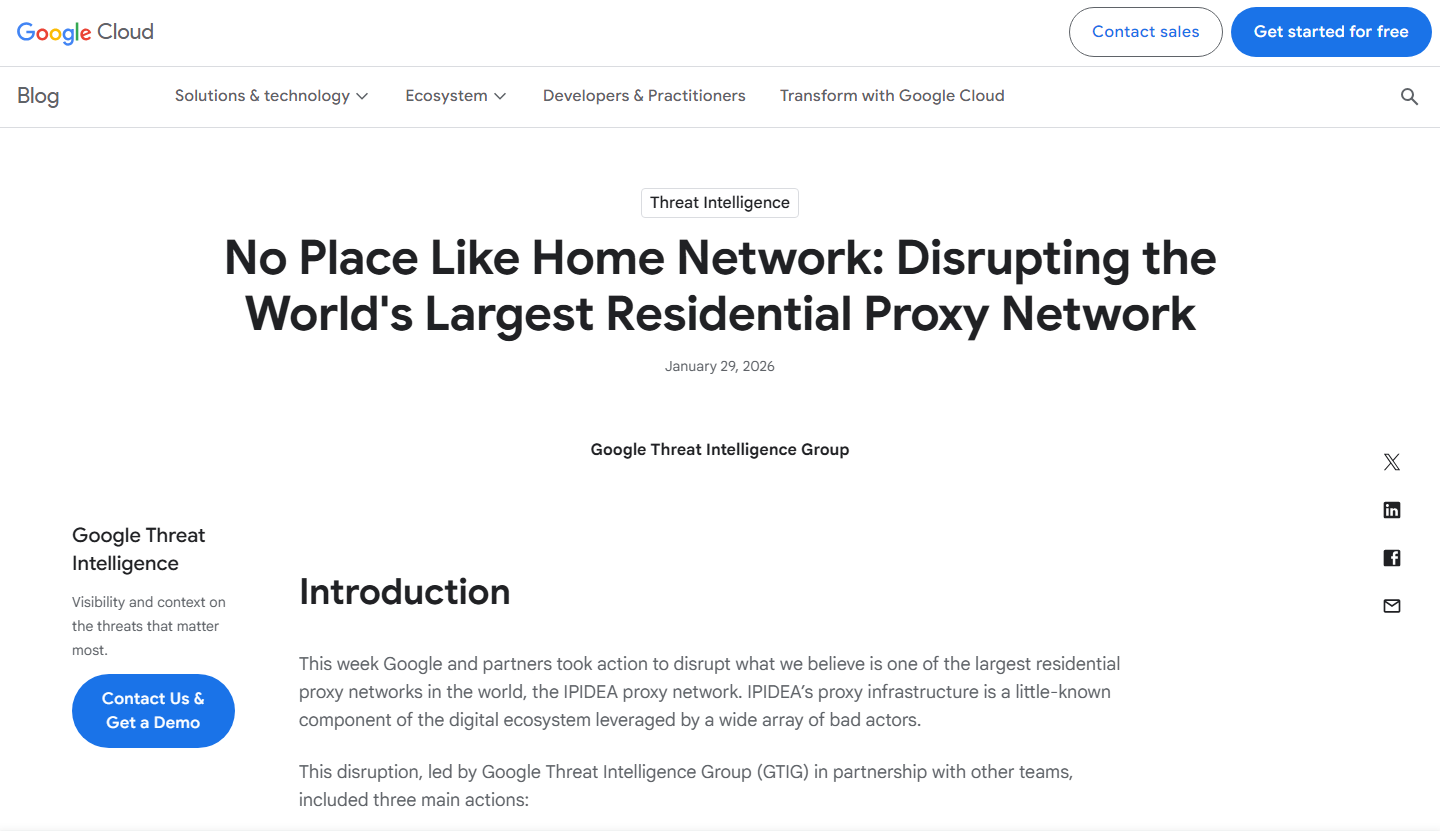
Source: Google Threat Intelligence Group, captured by ProxyRadar. This screenshot documents the published report; the detailed claims live in the linked original.
Luna Proxy positioned itself as a low-cost residential provider. Its published catalog advertised rotating residential proxies billed by traffic, static ISP addresses, datacenter IPs and "unlimited" style plans, with HTTP(S) and SOCKS5 support and a desktop proxy client for selecting exit locations.
Marketing pages claimed a very large pool — figures in the range of 200 million residential IPs across 190+ countries were common — with city and ISP targeting. These were vendor claims, never independently audited, and they describe a network that is no longer reachable through the original brand. They should not be treated as current capacity.
On January 28, 2026, Google Threat Intelligence Group (GTIG) published its investigation into IPIDEA and stated that many services marketed as separate providers were in fact controlled by the same actors. The named list explicitly included Luna Proxy (lunaproxy.com) alongside 360 Proxy, 922 Proxy, ABC Proxy, Cherry Proxy, IP2World, PIA S5 Proxy, PY Proxy, Tab Proxy and several VPN and SDK brands.
GTIG's technical indicators went further than a name on a list: the report included a file hash identified as a "Luna Proxy Client" among the Windows binaries connected to the infrastructure. According to Google, software embedded in mobile and desktop applications recruited residential exit nodes, and some applications did not clearly disclose that the user's device and home IP would become part of a commercial proxy network.
Across the wider ecosystem, GTIG documented more than 600 Android applications, roughly 3,075 Windows files and approximately 7,400 second-tier command-and-control servers, and observed more than 550 tracked threat groups using IPIDEA exits during a single seven-day window. These are network-wide figures — they do not prove that every Luna customer or every Luna IP was malicious, but they explain why legal, platform and security action followed.
Google described the outcome as significant degradation of the network and business operations, with the device pool reduced by millions. Reuters and multiple security outlets reported the same framing. That is strong evidence of disruption, not a declaration that the brand can never return.
On July 2, 2026, Google — this time in coordination with the FBI and Lumen — announced action against the NetNut residential proxy network (also tracked as "Popa"). In that write-up, Google stated it has "high confidence that many popular residential proxy brands are in fact whitelabeling the NetNut botnet," and warned that disrupted operators often "begin buying capacity from their competitors, effectively becoming a reseller."
This is important context, but it must be stated precisely. Google's NetNut post did not publish a new brand-by-brand list re-attributing Luna Proxy specifically to NetNut. What is established is (1) Luna was named in the January IPIDEA action, and (2) the ecosystem is fluid, with heavy pool-sharing between "competing" networks. Independent research (IPinfo) found that roughly nine of ten IPs seen in IPIDEA also appeared in other providers. So a defunct Luna storefront does not guarantee that "Luna capacity" vanished from the market — it may have been resold elsewhere.
lunaproxy.com does not resolve in our DNS checks; the site does not load.
Google explicitly named Luna Proxy in the January 2026 IPIDEA disruption and published a "Luna Proxy Client" indicator.
Independent trackers (for example Proxyway's 2026 market research) list lunaproxy.com in the "shut down" column.
No verified Luna announcement confirming permanent corporate closure, and no confirmed refund program, were found.
The evidence supports this wording:
Luna Proxy's website and retail service are unavailable after the IPIDEA disruption, and its original domain no longer resolves. There is no verified permanent-shutdown announcement, and part of the underlying pool may persist through resellers — which does not restore Luna's service.
Do not top up an old balance, pay an "unlock" fee, or install a Luna client from a mirror, Telegram link or search ad. After a domain disappears, copycat sites and reuploaded installers are prime phishing and malware vectors — especially given that Google flagged a Luna client binary.
Practical steps:
Rotate any password reused elsewhere, and revoke Luna API keys and credentials stored in browsers, antidetect profiles, scripts, CI secrets and servers.
Review access logs on important accounts for unfamiliar sessions or source-IP changes after the outage began.
If a Luna desktop client is still installed, quarantine or uninstall it, inspect startup entries and scheduled tasks, and run an updated endpoint scan. This is precautionary, not proof that every build was malicious.
For a possible refund, preserve invoices, transaction IDs and support messages, send one documented request to the last verified contact, and ask your card issuer or PayPal about dispute deadlines. Cryptocurrency payments normally have no chargeback.
A huge advertised pool and a low per-GB price do not prove informed consent from the people whose devices route your traffic. Before you buy anywhere, ask: who is the legal operator, how do device owners opt in and opt out, are upstream suppliers and resellers disclosed, and how are abuse complaints handled? Treat "100% ethical," "clean IPs" and "fully compliant" as marketing until backed by a DPA and auditable procedures, then run a small paid test measuring success rate, latency, geolocation accuracy, CAPTCHA rate and support responsiveness.
Commercial disclosure:ProxyUniverse is one partner option available through this publication. This mention is not an independent audit of its IP sourcing or compliance. Apply the same consent, ownership and performance checks and compare other providers before purchasing.
Its website is unavailable and its domain does not resolve, and Google named it in the IPIDEA disruption. No verified announcement confirms permanent corporate closure, so "currently unavailable and disrupted" is the accurate status.
Did Google prove every Luna IP was from an infected device?#
No. Google documented substantial trojanized and deceptive sourcing inside the shared IPIDEA supply chain, not that every single Luna IP was malicious.
Luna was named in the January IPIDEA action. Google's July NetNut post warns that "many" proxy brands whitelabel NetNut but did not publish a specific re-attribution of Luna to NetNut. Treat any such specific claim as unconfirmed.