Is Cherry Proxy Down? Status After the IPIDEA Disruption
Cherry Proxy's website and retail service appear unavailable. We separate storefront status from the partial recovery of underlying IPIDEA infrastructure.
Updated July 10, 2026: Cherry Proxy's public website and retail service appear unavailable. The evidence does not support the stronger claim that the company formally announced a permanent shutdown or that every part of the underlying network ceased to exist.
The accurate answer requires separating three layers:
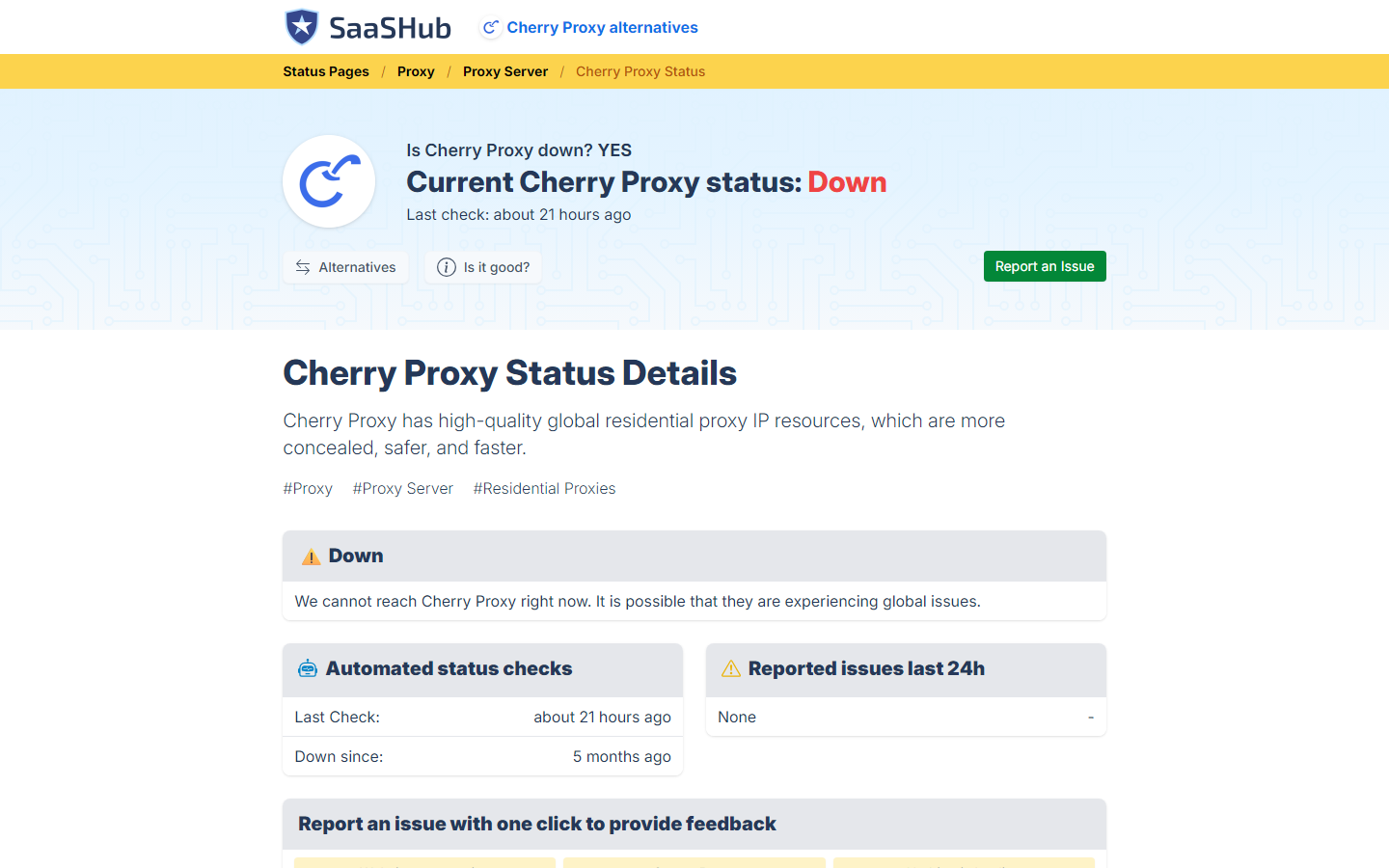
Website:cherryproxy.com is inaccessible and independent monitoring also reports it down.
Retail service: normal dashboard access, purchases, renewals and support cannot be verified.
Backend network: Google seriously disrupted shared IPIDEA infrastructure, but later research found that parts of that infrastructure recovered or were rerouted.
Customers should treat Cherry Proxy as unavailable and unsuitable for production, while recognizing that “permanently destroyed” remains unproven.
Source: SaaSHub public availability monitor, captured by ProxyRadar on July 10, 2026. This is supporting third-party telemetry, not an official closure announcement.
Cherry was not a new network built from scratch. On August 27, 2024, its official Telegram channel announced that 360Proxy had been renamed Cherry Proxy and directed customers from 360proxy.com to cherryproxy.com.
Links to older 360Proxy downloads, documentation and partner campaigns remained visible after the rebrand. The historical catalog included rotating residential, static residential, rotating ISP and SOCKS5 proxies with HTTP(S) and SOCKS5 support.
The company advertised more than 80 million residential IPs across 195+ locations and plans billed by traffic, IP or subscription period. Those were vendor claims, not independently audited capacity. They cannot be used as current network statistics after the storefront became unavailable.
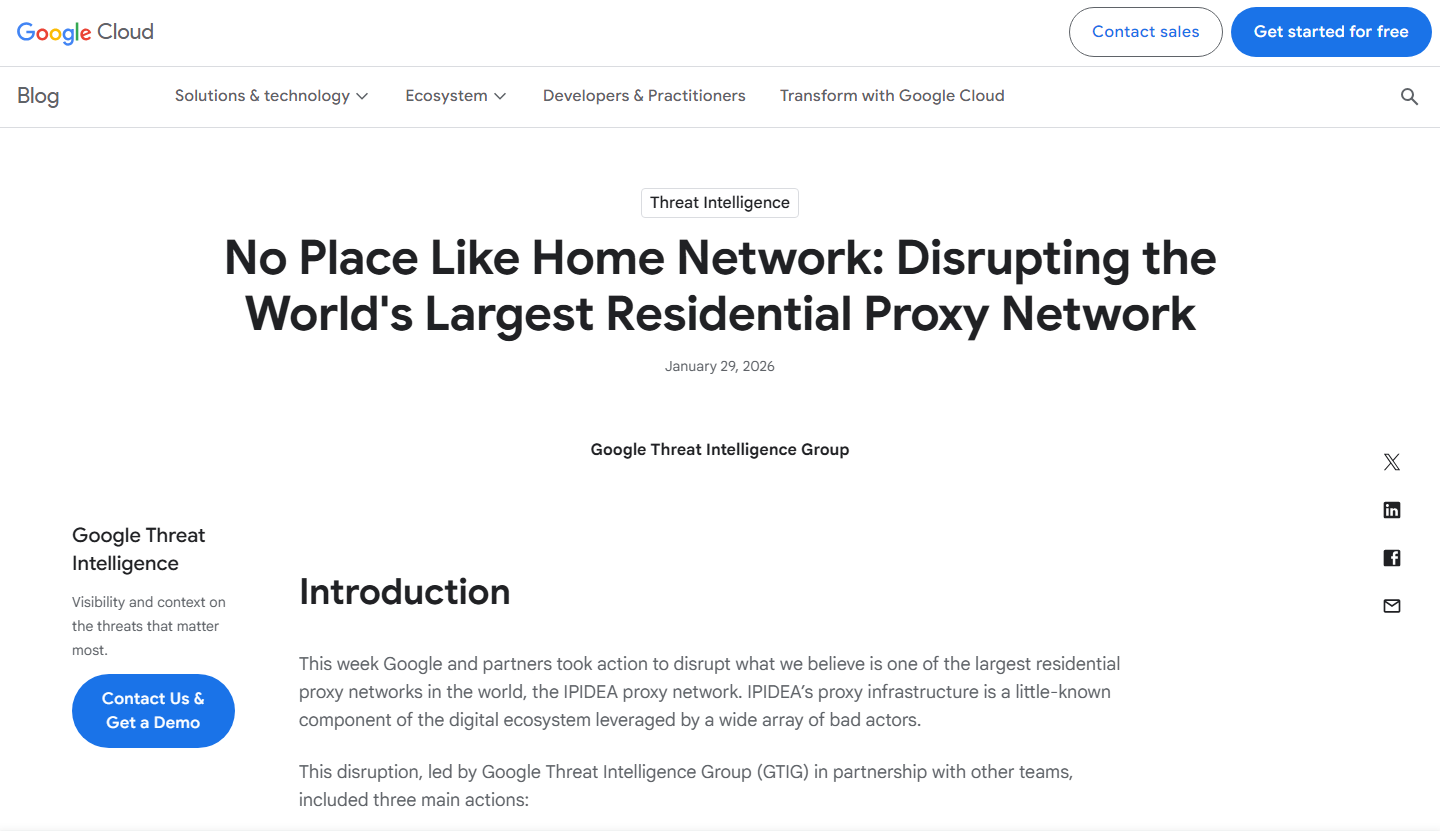
On January 28, Google Threat Intelligence Group published its investigation into IPIDEA. Google said many services marketed as separate providers were controlled by the same actors. The list explicitly included 360 Proxy, 922 Proxy, ABC Proxy, Cherry Proxy, IP2World, Luna Proxy, PIA S5 Proxy, PY Proxy, Tab Proxy and several VPN and SDK brands.
Source: Google Threat Intelligence Group, captured by ProxyRadar on July 10, 2026.
According to Google, software embedded in mobile and desktop applications recruited residential exit nodes. Some applications did not clearly disclose that the user's device and home IP would become part of a commercial proxy network. GTIG connected the infrastructure with activity involving BadBox 2.0, Aisuru and Kimwolf and observed more than 550 tracked threat groups using IPIDEA exits during one seven-day period.
The response combined legal action against control and marketing domains, technical intelligence sharing and stronger Google Play Protect enforcement against identified IPIDEA components.
Google described the outcome as significant degradation of the network and business operations and said the available device pool fell by millions. That is strong evidence of disruption, not proof of irreversible destruction.
Later telemetry from Bitsight makes a simple “everything disappeared” headline inaccurate.
After the January action, Bitsight lost direct visibility into IPIDEA-operated services for roughly 24 days. Its research accounts could not be replenished because customer-facing sites and related frontend infrastructure were offline.
Around February 25, Bitsight regained visibility and immediately observed approximately 2.24 million exit nodes, including nearly 300,000 devices associated with Vo1d infections. The researchers concluded that substantial device supply had survived, remained dormant or shifted through other wholesale channels while routing was rebuilt.
This does not prove that Cherry Proxy returned. A pool of exit nodes is different from a functioning Cherry domain, dashboard, billing system, account database, gateway and support team. The same backend capacity could be sold through resellers or other brands without restoring cherryproxy.com.
Cherry's website remains unavailable in current checks. Search engines still display product pages and prices, but indexed content can survive long after a live site stops working.
Domain-registration searches indicate clientHold and abuse-block nameservers. That status normally prevents a domain from resolving. The public record does not reveal the registrar's exact reason, so it should not be presented as proof of one specific complaint or court action.
No confirmed announcement from Cherry declaring permanent closure was found. Provider-attributed Trustpilot responses in February described the outage as maintenance. Months of unavailability make that a poor current status explanation, but it is still not a formal closure notice.
The evidence supports this wording:
Cherry Proxy's website and retail service are unavailable after the IPIDEA disruption. There is no verified permanent-shutdown announcement. Parts of the underlying network later reappeared in security telemetry, but that does not restore Cherry's customer service.
Do not top up an old account, send cryptocurrency to an unofficial support contact or install software from a mirror claiming to restore Cherry access.
Change any password reused elsewhere. Revoke API keys and remove stored credentials from browsers, antidetect profiles, automation tools, CI secrets and servers. Teams should review access logs for unexpected activity after the outage began.
Systems that ran Cherry or 360Proxy clients deserve a precautionary review: uninstall unneeded software, inspect startup entries and scheduled tasks, run current endpoint scans and investigate unexplained outbound connections. This does not mean every version of the client was proven malicious.
For a possible refund:
Save invoices, transaction IDs, outage screenshots and support messages.
Send one documented request through the last verified support address.
Ask a card issuer or PayPal about dispute deadlines.
Describe facts rather than making an unsupported fraud allegation.
Remember that cryptocurrency normally has no chargeback.
Do not make another payment to “unlock” the old balance.
A large pool and low price do not prove informed consent. Ask how device owners join and leave the network, which legal entity operates it, whether suppliers are disclosed, how abuse complaints are handled and whether privacy and data-processing terms are available.
Treat “100% ethical,” “clean IPs” and “fully compliant” as marketing until supported by documents and auditable procedures. Test a small amount on your actual targets, measuring connection success, latency, geolocation accuracy, CAPTCHA rate, session stability and support response.
Commercial disclosure:ProxyUniverse is one partner option available through this publication. This mention is not an independent audit of its IP sourcing or compliance. Apply the same consent, ownership and performance checks and compare other providers before purchasing.
Google significantly disrupted IPIDEA and affected Cherry. No verified Cherry announcement confirms permanent closure, so “currently unavailable” is more accurate.