Is 9Proxy Down in 2026? Verified Status, Timeline & Alternatives
9Proxy's website is back and our monitoring reads it operational, but new purchases are still paused and full proxy stability is unconfirmed. Here is the verified July 15 status, timeline, and the best alternatives.
9Proxy is not fully down: the public site is back and reads operational on our monitor (~99.86% uptime), but new purchases are still paused.
Full proxy stability is unconfirmed — treat this as a reliability event, and test authenticated sessions before trusting production traffic.
No evidence of a seizure. We describe it as an unconfirmed outage of unknown cause, separate from the NetNut FBI action.
What to do now: keep a funded fallback ready — see the ranked 9Proxy alternatives.
Last updated July 15, 2026. Quick answer: 9Proxy is not fully down. Its public website, login page, registration, documentation and downloads all load, and ProxyRadar's own monitoring reads the 9Proxy web surface as operational — roughly 99.86% uptime over the trailing 7 days at about 174 ms response time (last probe July 15, 2026, 12:55 UTC). However, new purchases are still officially paused on the pricing page, recent service reports are mixed, and 9Proxy has not published a full all-clear.
The honest description is partially restored and still recovering. A working homepage plus healthy uptime on our probe is meaningful progress after the disruption that began around June 28, 2026. It does not, on its own, prove that authenticated proxy sessions are stable across every plan, region and protocol — and the still-active purchase pause tells you 9Proxy does not yet consider itself back to normal either.
Based on checks on July 15, 2026, here is the split most people are actually asking about:
Public website (9proxy.com): up. The homepage, pricing, dashboard sign-in, registration and app downloads all respond.
Our independent monitoring: the 9Proxy public endpoint is marked operational — 99.86% uptime over 7 days, ~174 ms median, ~203 ms p95 across 288 checks in the last 24 hours. You can see the live figures on our 9Proxy status page and the full network status board.
New purchases:still paused. 9Proxy's own banner reads "New Purchases Are Temporarily Paused … to ensure we can properly support our current customers first."
Authenticated proxy service: unverified. We do not hold a paid 9Proxy account, so we cannot certify that live IP/GB sessions are stable for every customer. Recent third-party user reports remain mixed.
So "is 9Proxy down?" has a two-part answer: the site is up and our monitor is green, but commercial sales are still frozen and full proxy stability is unconfirmed. Treat it as a reliability event, not a one-hour glitch.
Reports began clustering on June 28. Customers described the same combination of failures: the website would not load, the desktop application timed out, active sessions stopped working, and prepaid IP or bandwidth balances could not be used through the normal interface. Some users also reported slow or unavailable support.
This was more than a marketing-site outage. The affected components included account login, dashboard access, the desktop application, creation and maintenance of proxy sessions, and access to already purchased capacity.
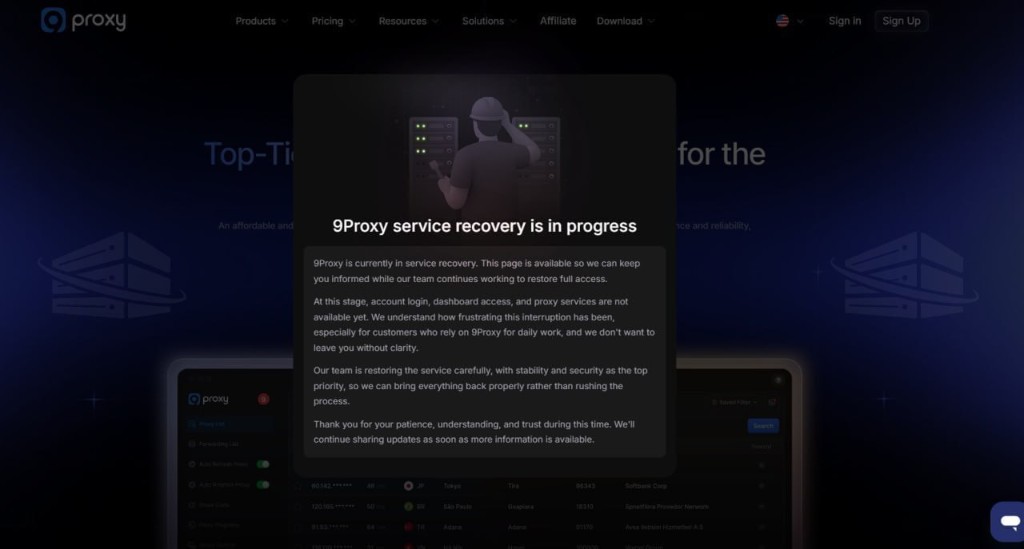
During recovery, 9Proxy displayed a notice stating that account login, dashboard access and proxy services were not yet available. The company said stability and security were taking priority over a rushed reopening.
A separate maintenance screen showed that the platform was undergoing recovery rather than operating normally.
Community reports and third-party monitors point to June 28 as the start of the major interruption. Reported symptoms included Cloudflare or hosting errors, desktop-app timeouts, interrupted sessions and an inability to use capacity that customers had already paid for.
June 29 UTC / June 30 in UTC+7: official acknowledgement#
9Proxy published a Facebook notice beginning, “We're currently experiencing a service disruption.” The post appears as June 30 at 05:17 in UTC+7, approximately June 29 at 22:17 UTC.
The notice referred to an “unexpected issue,” called the incident the team's top priority and said it was pursuing a stable and secure recovery rather than a rushed fix. It did not provide an exact restoration time.
Independent coverage still described login and application failures. Some uptime checks could already receive HTTP 200 from the public domain, illustrating an important limitation: a Cloudflare-backed homepage can respond while authentication, proxy allocation and relay infrastructure remain unavailable.
Around July 6: first visible reports of restored access#
Comments under the official notice included “9proxy is back on” and “It's working now.” These are useful recovery signals, but they are not an official completion notice. The comments do not identify plan type, region, protocol, application version or duration of testing.
SaaSHub and SaaSWorthy recorded user reports labelled “All Proxy's are failing” and “Server Down.” Self-submitted reports cannot establish the proportion of affected customers, but they argue against calling the recovery universal.
July 10: public surfaces are back, sales remain paused#
The homepage loads, the dashboard URL presents a sign-in form, and registration and download pages are reachable. The official pricing page still says that new purchases are temporarily paused while 9Proxy focuses on existing customers.
July 15: website stable on our monitor, purchases still paused#
Two weeks after the disruption began, the public site is consistently reachable and our own probe records the 9Proxy web surface as operational (99.86% uptime, ~174 ms). The purchase-pause banner is still live on the pricing page, which means 9Proxy itself has not declared normal operations resumed. This is the current status as of the last update to this article.
There is no verified single recovery date. Public and account-entry pages appear to have returned by roughly July 6, while service-level reports remained uneven afterward and sales have stayed closed.
9Proxy status: what our monitoring actually shows#
ProxyRadar continuously probes a public 9Proxy endpoint from a monitored region and publishes the raw numbers, rather than guessing. As of July 15, 2026 that probe reports:
Status: operational
Uptime (7-day): 99.86%
Response time: ~174 ms median, ~203 ms p95
Sample: 288 checks in the trailing 24 hours from one configured probe region
Two caveats keep this honest. First, this measures 9Proxy's public web availability, not authenticated residential-proxy delivery — see the next section on why those are different. Second, it is a single probe region, so it is a signal, not a full-coverage SLA. The always-current version of these numbers lives on the 9Proxy status page; the provider hub collects our 9Proxy coverage in one place.
An uptime monitor usually requests a public URL and records its response code. A green “Up” result confirms that a web server answered; it does not verify that a paying customer can:
authenticate and see the correct balance;
generate a residential endpoint;
establish an authenticated HTTP or SOCKS5 session;
keep a sticky session alive;
rotate to a fresh address;
receive the selected country or city;
reach the actual target under normal load.
This explains the apparently conflicting evidence. A status service can mark the website up while users still report application or proxy failures. For operational decisions, authenticated tests against real targets are more useful than homepage uptime.
There are signs of residual or uneven instability. The official purchase pause indicates that 9Proxy does not yet consider normal sales ready to reopen. Recent user reports add evidence of continuing service problems. At the same time, reachable account pages and positive recovery comments show that the platform is not completely offline for everyone.
It would be inaccurate to claim that most customers are affected or that every pool is unstable. No representative public benchmark covers authenticated accounts, IP-based and GB-based plans, regions and protocols. The honest conclusion is limited: full stability has not yet been demonstrated.
Why is 9Proxy down? The cause is still unconfirmed#
9Proxy has not published a root-cause analysis. Its official notice referred only to an "unexpected issue" and said the team was prioritising a stable, secure recovery over a rushed reopening. That is the extent of what the vendor has actually confirmed.
Some articles call the event a confirmed "infrastructure failure," but that wording largely traces back to IPcook, a competing proxy seller that promoted alternatives in its coverage. Its description of visible symptoms may be useful; its explanation of the cause is not independent confirmation.
There is no primary evidence proving a database failure, hosting dispute, cyberattack, loss of residential supply, regulatory intervention or law-enforcement seizure. Anyone telling you exactly why 9Proxy went down is speculating unless they cite a primary source. The verifiable facts are narrow: symptoms started around June 28, 9Proxy acknowledged a disruption, the site later came back, and sales are still paused.
No credible primary source supports either claim, and we do not describe 9Proxy as seized.
A July 1 investigation by ProxyStats found ordinary Cloudflare nameservers, a normal registrar transfer lock, registration extending into 2027 and no outage-period registry change resembling a government takeover. There was no seizure banner, agency announcement, indictment or court filing tied to 9Proxy.
Confirmed proxy-network takedowns normally produce named agencies, legal documents, seized domains or technical reports. None has appeared for 9Proxy. Until new evidence is published, the correct description is an unconfirmed outage / access disruption of unknown cause — not a seizure and not an IPIDEA event.
It is reasonable to ask the question because 2026 has been a brutal year for the proxy industry, and that background is why "was 9Proxy seized" trends at all. Framed accurately, and kept separate from 9Proxy's own situation:
January 2026 — IPIDEA-linked disruption. A cluster of IPIDEA-family and reseller brands went dark or unstable, including PIA S5 Proxy, 922 S5 Proxy, ABCProxy and Cherry Proxy. Reporting tied these to a common upstream supplier rather than to a single confirmed seizure.
July 2026 — NetNut. NetNut's situation has been reported as a law-enforcement (FBI) action, which is a different, better-attributed category of event than 9Proxy's.
9Proxy sits in the same nervous market, which is exactly why its outage drew "seizure" rumours. But sharing a calendar year with those events is not evidence. On the facts we can verify, 9Proxy is a recovering service with paused sales, not a taken-down network.
If your 9Proxy sessions fail even though the website loads, work through the cheap checks before assuming a full outage:
Confirm it is 9Proxy, not you. Load our 9Proxy status page. If our probe is green but you still fail, the problem is more likely local or account-specific.
Re-authenticate. Sign in fresh, confirm your balance and plan are correct, and regenerate credentials — password rotations and IP-allowlist changes during recovery can silently break old ones.
Update the desktop app. IP-based plans route through the 9Proxy client; timeouts often clear after updating to the current build.
Test HTTP and SOCKS5 separately, and try a second location — a single dead pool is not the whole network.
Switch networks. Retry from another machine or connection to rule out local firewall, DNS or ISP interference.
Check for a purchase pause. If you were trying to buy or top up, that is expected: new purchases are still paused, so this is a commercial limitation, not a technical fault.
If sessions still fail after that, treat 9Proxy as unreliable for now, keep a funded fallback ready, and read the alternatives section below.
Do not restore production traffic because the login form opens. Test the exact workflow your operation uses:
sign in and verify balances and plan history;
check IP-based and GB-based products separately;
generate a small number of endpoints in required locations;
test HTTP and SOCKS5 independently;
verify password authentication and IP allowlisting;
hold sticky sessions long enough to reveal early disconnects;
test manual and scheduled rotation;
measure connection success, target success, latency and session lifetime;
repeat from another local network or machine;
record timeout, authentication and upstream error codes;
run limited production volume for 24–48 hours before scaling.
An IP-check page is insufficient. A proxy can display an address successfully while failing against the websites, APIs or account workflows that matter.
Keep a funded fallback and return traffic in stages. The cheap residential proxies guide covers broader evaluation criteria.
With sales paused and full stability unproven, the practical move is to keep a working provider ready even if you plan to return to 9Proxy later. The alternatives below are residential-first, credible, and — importantly — the ones we actively monitor, so you can check their live status the same way you check 9Proxy's.
Like-for-like residential replacements
NovProxy — clean residential pool with straightforward pricing; a close swap for a general-purpose 9Proxy setup.
711Proxy — broad geo coverage for scraping and multi-account work.
Swiftproxy — value-focused residential access with sticky sessions.
IPRocket and LokiProxy — additional residential options worth benchmarking before you commit budget.
If you buy by bandwidth (like 9Proxy's GB plans)
PIA Proxy's pay-per-GB comeback — after the January turmoil, PIA reintroduced GB-based residential pricing, which maps cleanly onto how 9Proxy GB customers already budget.
Disclosure: ProxyUniverse is a commercial partner we promote. The links below are affiliate links; we may earn a commission, and it does not change what you pay.
If you want the alternatives above (and often 9Proxy itself) in one place, ProxyUniverse is a multi-provider reseller panel. Because it aggregates several networks, the per-unit price is frequently lower than buying each provider direct, and you can switch networks from one dashboard the moment one starts failing — which is exactly the resilience an outage like this rewards.
This is a commercial option, not a price or availability guarantee. Inventory, packages and terms change, so check the current product, region coverage, delivery method and refund terms before paying. Buying through a reseller also does not remove the need to test the underlying network with the recovery checklist above.
If browser profiles are part of the setup, avoid changing both the proxy and profile configuration at the same time. The Dolphin Anty overview covers that separate layer.
This is one of the most common questions during the outage, so here are the verifiable facts rather than promises:
9Proxy publishes a Refund Policy (linked in its site footer). Refund eligibility and windows are governed by that policy, not by us — read the current version before you file.
On 9Proxy's own terms, GB-based traffic stays valid for 180 days (Enterprise plans can be unlimited) and unused IP-based balances do not expire — your balance only decreases when an IP is actually used. That means paused sales do not, by themselves, erase what you already bought.
If you cannot reach or use a paid balance, open a support ticket, keep written records (dates, screenshots, error codes), and if you paid by card and get no resolution, a chargeback is the standard fallback.
Because purchases are still paused, the safest position is to not commit new spend to 9Proxy right now and to keep a funded alternative running instead.
This review uses official 9Proxy pages, the company's Facebook notice and comments, its public Telegram archive, third-party uptime monitors, community reports, independent or commercially interested coverage, and ProxyRadar's own monitoring of a public 9Proxy endpoint.
No authenticated customer account was provided for endpoint testing, and no representative sample of IP-based and GB-based pools was benchmarked. Our monitoring and other automated monitors mostly test public web availability from limited probe regions; social reports are self-selected; and 9Proxy has not published component metrics, a status history or a root-cause report. For those reasons, page availability is separated from unverified proxy-network performance throughout this article.
Not completely. As of July 15, 2026 the public site loads and our monitor reads it operational (99.86% uptime, ~174 ms). But new purchases are still paused, recent service reports are mixed, and there is no official all-clear on full proxy stability.
The website and account entry points work. Whether your proxies work is separate — test authenticated HTTP and SOCKS5 sessions against your real targets before trusting production traffic.
There is no confirmed full-restoration date. Public pages returned around July 6, some new failures were reported around July 8, and the site has been stable on our monitor since. Sales remain paused.
The cause is unconfirmed. 9Proxy acknowledged an "unexpected issue" but never published a technical explanation, and no primary evidence points to a specific cause.
No. There is no seizure notice, agency announcement, indictment or relevant domain takeover. We describe it as an unconfirmed outage, not a seizure. Other 2026 events — the January IPIDEA-linked disruptions and the NetNut FBI action — are separate.
Refunds follow 9Proxy's published Refund Policy. Note that GB traffic stays valid for 180 days and unused IP balances do not expire, so a paused store does not erase what you bought. Keep records and use a card chargeback as a last resort.
It may be, depending on the current offer. ProxyUniverse is a disclosed commercial partner (affiliate) that resells multiple networks from one panel; verify live pricing, inventory and terms.
June 28: widespread website, application and proxy failures begin.
June 29 UTC / June 30 UTC+7: 9Proxy acknowledges the disruption without a restoration ETA.
July 1: login and application remain materially unavailable.
Around July 6: first visible customer comments report restored operation.
Around July 8: new server and proxy-failure reports appear.
July 10: site and login surfaces are back; purchases remain paused; full stability is not confirmed.
July 15: website consistently reachable and operational on our own monitor (99.86% uptime, ~174 ms); new purchases still paused. Added a monitoring section, expanded alternatives with interlinks, 2026 takedown-wave context, troubleshooting and refund guidance.