Hide Proxy Review 2026: A Cheap 9Proxy Alternative?
Hide Proxy is a low-cost, per-IP residential network pitched at e-commerce, scraping and multi-accounting. Here is an honest look at its real pricing, products and limits — and where it fits for anyone leaving 9Proxy.
What it is: Hide Proxy is a budget, per-IP residential network (hideproxy.io) built around e-commerce checkout, scraping and multi-account work, advertising 20M+ IPs across 90+ countries.
The price hook: its headline is per-IP with unlimited bandwidth from about $0.015/IP (a volume rate) plus a static-residential line — cheap enough to matter if you left 9Proxy for cost reasons.
The catch: pool size, uptime and success figures are vendor-reported, the public corporate footprint is thin, and the pricing page's GB table was empty at our visit — so test a small order before you scale.
Hide Proxy is one of a new wave of low-cost residential networks that compete almost entirely on price per IP rather than brand recognition. It leans hard into a specific audience — sneaker and retail checkout, price monitoring, ad verification, SERP tracking and social-media multi-accounting — and packages a large advertised residential pool behind a simple pay-per-IP model with unlimited bandwidth. If you came here because 9Proxy paused new purchases and you want something similarly cheap, Hide Proxy is squarely in that tier.
This review separates what Hide Proxy verifiably offers from the numbers it advertises, and is honest about where the facts are self-reported rather than independently audited.
Hide Proxy, which you'll find at hideproxy.io, brands itself as a "peer-to-peer" residential proxy network — meaning its IPs come from real consumer devices rather than datacenters. The marketing is unusually focused for the category: instead of the generic "190+ countries, enterprise-grade" pitch, it talks directly about failed checkouts on Amazon, Nike and eBay, block rates on marketplaces, and keeping social accounts alive. That positioning tells you who it is really for.
At the time of writing, the site is Vietnamese-first with an English toggle, support runs through Telegram, and it is a relatively young, thinly-documented brand. Treat ownership, scale and performance statements as vendor-supplied until you have tested them yourself.
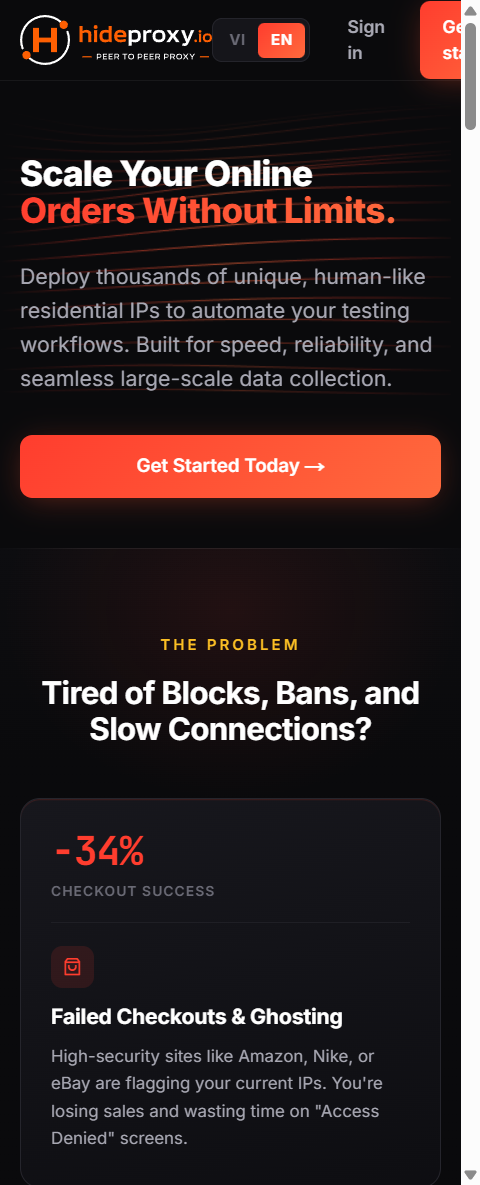
hideproxy.io captured in July 2026: a residential, e-commerce-focused pitch built around checkout success, speed and geo-targeting.
Hide Proxy runs two pricing models, and getting them straight matters because our whole approach is price-first:
Residential Proxy — per IP. This is the flagship: you pay per independent IP with unlimited bandwidth, advertised from about $0.015/IP. That headline is a volume rate — small quantities cost more per IP — but the model itself is attractive for anyone who burns a lot of bandwidth, because you are not metered by the gigabyte. Each IP supports sticky sessions up to 6 hours, auto-refresh and auto-rotation, and country/state/city/ASN targeting.
Static Proxy — per IP. Fixed residential IPs that hold the same identity for weeks or months, over HTTP/HTTPS/SOCKS5, with country-level targeting. Static plans are quoted as custom via support/Telegram.
The site also references per-GB residential pricing in places, but the GB package table was not populated at the time of our visit, so treat any per-GB figure as "confirm on the dashboard" rather than a fixed spec. Payments advertised include crypto (BTC, ETH, USDT), card/VISA and local bank transfer. We did not find a clearly advertised free trial, so the cheapest way in is the smallest per-IP bundle.
Honest framing: the per-IP, unlimited-bandwidth model is genuinely different from 9Proxy's rotating GB pricing, and can be much cheaper for bandwidth-heavy jobs — but the sub-$0.02/IP number is a best-case volume rate, not what you pay for five IPs. Price a realistic quantity before comparing it to anything.
Protocols: HTTP/HTTPS and SOCKS5 (the network is described as a residential SOCKS5 proxy).
Targeting: country, state, city and ISP/ASN.
Advertised pool: 20M+ verified residential IPs across 90+ countries, with top locations listed as the US, UK, Vietnam and Germany.
Access: dashboard plus API; Telegram support.
Vendor claims: 99% success rate and 99.9% uptime, plus on-site testimonials (a 4.9 rating, "2.4k+ verified reviews", 98% would recommend). None of these are independently audited.
Best for
Bandwidth-heavy e-commerce, scraping and multi-account work where a cheap per-IP, unlimited-bandwidth model beats paying by the gigabyte — provided you validate the pool on your own targets first.
This is the practical reason most people find Hide Proxy right now. After 9Proxy paused new purchases in 2026, a lot of buyers who valued it for being cheap and simple need a replacement they can start using today — not an enterprise contract. Hide Proxy fits that brief on price, but it is not a like-for-like swap:
Billing shape differs. 9Proxy's rotating residential is typically bought by the gigabyte; Hide Proxy's flagship is per IP with unlimited bandwidth. If your workload is bandwidth-heavy, per-IP can be cheaper; if you buy tiny amounts occasionally, per-GB may still suit you better. If you specifically budgeted 9Proxy by the gigabyte, also look at the pay-per-GB options in our 9Proxy alternatives guide.
Setup is familiar. HTTP/SOCKS5, sticky sessions and country/city targeting map onto a typical 9Proxy configuration, so migration is mostly re-pointing endpoints.
Maturity is lower. 9Proxy has a longer track record and more third-party coverage. Hide Proxy is newer and thinner on independent verification, which is exactly why you should test before trusting it with important accounts.
For the wider context on why so many budget brands are in flux this year, see our 2026 proxy takedowns tracker, and line providers up side by side with the compare tool.
Use it if you want cheap residential IPs for e-commerce checkout, marketplace scraping, ad/price monitoring, SERP tracking or social multi-accounting, you run enough bandwidth that a per-IP unlimited model saves money, and you are prepared to test rigorously before scaling.
Skip it if you need audited sourcing, contractual SLAs and documented data-protection guarantees — a compliance-focused enterprise provider (Bright Data, Oxylabs, Decodo) is the right tool for that, at a higher price. Hide Proxy competes on cost, not on compliance paperwork.
It is a real, operating residential proxy service with a dashboard, API and Telegram support. "Legitimate" in the compliance sense depends on sourcing transparency, which Hide Proxy does not fully document — so ask directly and test before trusting it with important work.
Its flagship is per-IP with unlimited bandwidth, advertised from about $0.015/IP as a volume rate, plus a static-residential line quoted via support. A per-GB tier is referenced but was not populated when we checked, so confirm live pricing on the dashboard for the quantity you actually need.
On price and setup, yes — it targets the same budget tier. The main differences are billing shape (per-IP unlimited vs per-GB) and maturity, so treat it as a value replacement to validate, not a guaranteed one-to-one match.